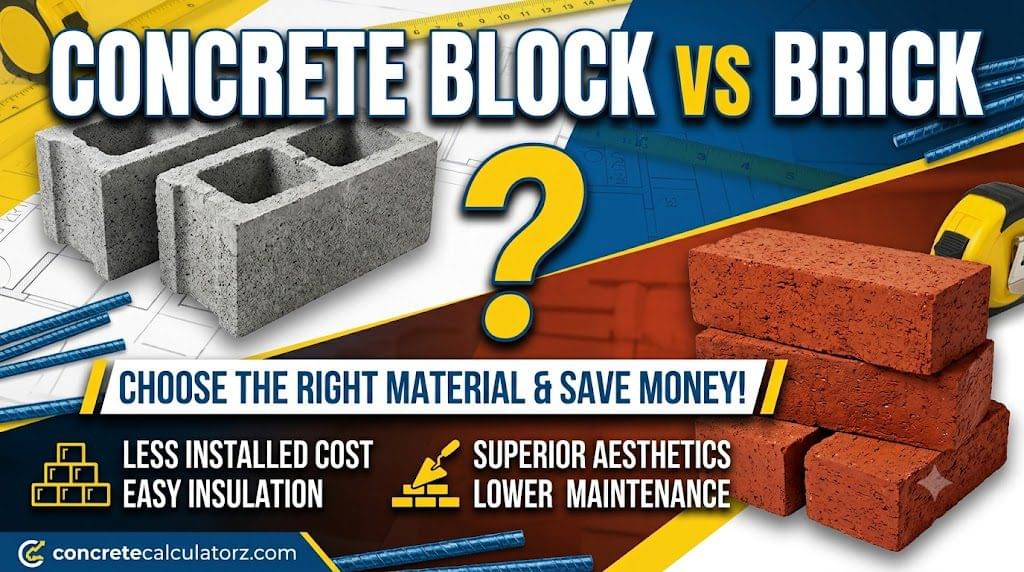
If you are standing in the aisles of a home improvement store or staring at a construction blueprint, it is easy to get overwhelmed by masonry terminology. You will hear contractors, structural engineers, and DIYers toss around terms like concrete block, cinder block, cement block, and brick as if they are interchangeable.
But are they actually the same thing? Not quite. Using the wrong material for a home foundation, retaining wall, or structural partition can compromise your build or blow your budget.
This comprehensive, human-friendly guide breaks down the true differences, structural strengths, costs, weights, and mixing ratios so you can make an expert choice for your project.
Are Cinder Blocks the Same as Concrete Blocks?
The short answer is no, but they belong to the same family.
In modern construction, almost all large, hollow gray blocks are technically classified as CMUs (Concrete Masonry Units). However, the true difference lies entirely in their composition—specifically, the aggregate mix used to bind them together.
What is the Difference Between Concrete Blocks and Cinder Blocks?
Concrete Blocks are manufactured using a clean mixture of Portland cement, water, and heavy aggregates like crushed stone, gravel, and fine sand.
Cinder Blocks use a similar cement and water base, but replace the heavy stone aggregate with fly ash, bottom ash, or industrial cinders—which are the residual byproducts of burning coal.
What about Cement Blocks?
If you are wondering what is the difference between a cinder block and a cement block, “cement block” is simply a casual, umbrella term people use for both. Cement is just the binding powder; it is not a standalone structural material.
concrete block vs cinder block which is strong and better
How to Tell the Difference Between Cinder Block and Concrete Block
Because modern manufacturing plants rarely produce pure, old-school coal cinder blocks for structural residential use anymore, true vintage cinder blocks are usually found in older homes or specialized decorative projects. You can tell them apart using three distinct physical traits:
Texture: Concrete blocks feel hard, dense, and uniformly gritty like an asphalt sidewalk. Cinder blocks have a noticeably rougher, porous, and almost pitted texture.
Color: Concrete blocks are a uniform, light stone-gray. Cinder blocks typically have a darker, charcoal-gray hue with tiny dark flecks visible in the aggregate matrix.
The Sound Test: If you gently tap a solid concrete block with a hammer, it lets out a sharp, high-pitched metallic ring. Tapping an old cinder block yields a duller, hollow thud.
Strength & Structural Integrity: Which is Stronger?
When asking which is stronger, a cinder block or a concrete block, the undisputed winner is the solid concrete block.
Because concrete blocks utilize hard gravel and stone aggregates, they possess incredible compressive strength. They can withstand immense vertical load-bearing pressure without buckling, bowing, or crumbling under tension.
Cinder blocks, on the other hand, are significantly structurally weaker. The coal ash aggregate is naturally brittle, making the block prone to shearing, structural cracking, or snapping if subjected to heavy load-bearing demands or intense lateral ground pressures.
Concrete Block vs. Bricks (The 3-Way Showdown)
When planning walls, fences, or patios, you will likely find yourself choosing between concrete blocks, cinder blocks, and traditional clay bricks.
Concrete Block vs. Bricks
Traditional bricks are made from kiln-fired clay. They are incredibly dense, weather-resistant, and visually appealing, making them the premier choice for exterior architectural facades. However, bricks are small. Building a massive structural wall purely out of brick takes significantly longer and requires far more labor and mortar joints than laying large, modular concrete blocks.
Comparison Matrix: At a Glance
Feature
Concrete Block (CMU)
Cinder Block
Traditional Clay Brick
Primary Ingredient
Portland Cement + Crushed Stone
Portland Cement + Coal Ash
Kiln-Fired Clay
Compressive Strength
Exceptionally High
Medium to Low
High
Moisture Resistance
High (When sealed properly)
Low (Highly porous)
Very High
Best Used For
Load-bearing walls, foundations
Internal partitions, light gardens
Exterior accents, chimneys, patios
Weight & Mass Breakdown
The aggregate variation creates a massive gap in physical density. If your project involves lifting hundreds of blocks by hand over a weekend, you will feel this difference immediately.
Cinder Block Weight: Because coal ash is incredibly lightweight and packed with tiny air pockets, a standard hollow 8″ x 8″ x 16″ cinder block weighs roughly 26 to 28 lbs.
Concrete Block Weight: The heavy stone gravel and dense sand fill inside a standard hollow 8″ x 8″x 16″ concrete block pushes its weight to 35 to 40 lbs.
Solid Concrete Blocks: If the block is completely solid (no hollow core cells), a concrete unit of the same size can easily tip the scales at over 50 to 60 lbs .
Foundation Wars: Cinder Block vs. Concrete Block
If you are planning a home addition, a garage, or a structural workshop, your foundation material choice is non-negotiable.
Solid Concrete Block vs. Cinder Block Foundations
Never use true cinder blocks for a structural home foundation. Cinder blocks are highly porous. Over time, moisture from the surrounding soil will seep into the hollow core cells of a cinder block foundation, causing the brittle coal ash to degrade, decay, and buckle under the freezing and thawing cycles of winter weather.
A concrete block foundation is a code-approved, incredibly resilient choice. When reinforced internally with vertical steel rebar stems and filled completely with fluid concrete grout, a concrete block wall provides immense structural integrity that can easily hold back soil shifting and support the entire weight of a multi-story building.
Cost Analysis: Budgeting Your Project
When comparing cinder block vs. concrete block costs, the prices fluctuate based on your regional manufacturing yards and bulk delivery fees.
Standard Concrete Blocks (CMUs): Typically cost between $1.50 to $3.00 per block at retail stores. Because they are the modern construction baseline, buying them in bulk pallets often drives the price down closer to the lower end.
Cinder Blocks: True vintage or specialty lightweight recycled blocks can sometimes cost slightly less or significantly more depending on availability. However, because they cannot be used for code-compliant structural walls, any upfront material savings are wiped out by their limited real-world utility.
Labor Adjustments: While concrete blocks are slightly more expensive to transport due to their raw weight, they are faster to install than traditional clay bricks, drastically lowering your total masonry contractor labor fees.
The Master Concrete Block Ratio
If you plan to cast your own concrete blocks manually using modular molds, or if you need to pour core-fill grout down into the open cells of your laid blocks, matching the correct structural mixing ratio is vital.
The industry-standard volumetric structural recipe for strong, durable concrete blocks is known as the 1:2:3 Ratio:
1 Part: Portland Cement (Provides the chemical binding power)
3 Parts: Crushed Stone Aggregate or Coarse Gravel (No larger than 1/2\ (-inch) chips to ensure a smooth pour)
Water: Add slowly until the mixture reaches a damp, moldable earth consistency—it should hold its shape when squeezed firmly in your hand without dripping excess water.
Summary Checklist: Which Should You Buy?
Choose Concrete Blocks if you are building load-bearing walls, structural home foundations, retaining walls holding back heavy soil, or anything requiring building code compliance.
Choose Cinder Blocks (or lightweight utility CMUs) if you are working on small, non-load-bearing DIY projects, such as basic raised garden beds, quick backyard benches, or interior privacy partition walls.
Choose Clay Bricks if your primary goal is timeless architectural beauty, decorative accent work, or traditional outdoor fire pits and patio walkways.
Engineer Nazim is an engineer dedicated to breaking down complex structural and concrete problems into practical, actionable data for DIYers, contractors, and construction experts. From concrete calculations to field guide logistics, he focuses on real-world solutions that work on-site.