Whether you’re pouring a backyard patio, a driveway, or a set of deck footings, running out of concrete mid-pour is a nightmare. Order too little, and your slab will have cold joints. Order too much, and you’re paying for material you can’t return.
The good news? Calculating concrete volume is straightforward once you understand the universal formula. This guide walks you through the math step-by-step, covers every common project type, and shows you how to convert your measurements into cubic yards, cubic feet, and the exact number of bags you’ll need to buy.
The Universal Concrete Formula
Every concrete calculation starts with one simple concept: volume = length × width × depth (or height).
The only rule is that all three measurements must be in the same unit before you multiply them.
| If you measure in… | Your volume result will be in… | To get cubic yards, divide by… |
|---|---|---|
| Feet (ft) | Cubic feet (ft³) | 27 |
| Inches (in) | Cubic inches (in³) | 46,656 |
| Meters (m) | Cubic meters (m³) | 1 (already in m³) |
| Centimeters (cm) | Cubic centimeters (cm³) | 1,000,000 |
Standard industry practice: Contractors in the United States almost always order concrete by the cubic yard (yd³). One cubic yard equals 27 cubic feet and covers approximately 80 square feet at 4 inches thick.
Step-by-Step: How to Calculate Concrete for a Rectangular Slab
Let’s work through the most common project—a backyard patio.
Step 1: Measure Your Dimensions
You want a patio that is 12 feet long, 10 feet wide, and 4 inches thick.
Step 2: Convert All Measurements to Feet
Thickness is usually measured in inches, so convert it to feet before multiplying:
- 4 inches ÷ 12 = 0.333 feet
Step 3: Multiply Length × Width × Thickness
- 12 ft × 10 ft × 0.333 ft = 40 cubic feet (ft³)
Step 4: Convert Cubic Feet to Cubic Yards
- 40 ft³ ÷ 27 = 1.48 cubic yards
Step 5: Add a Waste Factor
Concrete projects always generate waste from spillage, over-excavation, and uneven subgrade. Industry standard is 5–10% extra.
- 1.48 yd³ × 1.10 (10% buffer) = 1.63 cubic yards
Final order: Round up and order 1.7 cubic yards of concrete.
Pro Tip: If you’re buying bagged concrete instead of ordering ready-mix, 1.48 cubic yards equals roughly 67 bags of 80 lb concrete (since each 80 lb bag yields 0.60 cubic feet). With the 10% buffer, you’d need about 74 bags.
How to Calculate Concrete for Different Project Types
Not every pour is a simple rectangle. Here is how to handle the most common shapes and structures.
Concrete Slabs (Patios, Driveways, Shed Bases)
Formula: Length × Width × Thickness (all in feet) ÷ 27 = Cubic Yards
Typical thickness by application:
- Sidewalks and walkways: 4 inches
- Patios: 4 inches
- Driveways: 5–6 inches
- Garage floors: 5–6 inches
- Shed bases: 4 inches
Use our Concrete Slab Calculator to skip the manual math.
Concrete Footings
Footings run underneath walls and require calculating the volume of a long rectangular prism.
Formula: (Length in feet) × (Width in feet) × (Depth in feet) ÷ 27 = Cubic Yards per footing
Example: A footing that is 20 ft long, 12 inches (1 ft) wide, and 6 inches (0.5 ft) deep:
- 20 × 1 × 0.5 = 10 ft³
- 10 ÷ 27 = 0.37 cubic yards
If you have multiple footings, multiply by the number of footings. Our Footing Calculator handles bulk calculations instantly.
Round Columns, Piers, and Sonotubes
Circular shapes use the area of a circle multiplied by the height.
Formula: π × r² × h (all in feet) ÷ 27 = Cubic Yards
Where:
- π ≈ 3.1416
- r = radius (diameter ÷ 2)
- h = height or depth
Example: A deck pier with a 10-inch diameter (0.833 ft) and 3 ft depth:
- Radius = 0.833 ÷ 2 = 0.416 ft
- 3.1416 × (0.416)² × 3 = 1.63 ft³
- 1.63 ÷ 27 = 0.06 cubic yards per pier
For multiple piers, multiply accordingly. Check our Sonotube Calculator for common tube sizes and automatic bag counts.
Concrete Walls
Walls are essentially vertical slabs.
Formula: Length × Height × Thickness (all in feet) ÷ 27 = Cubic Yards
Standard wall thicknesses:
- Interior walls: 6 inches
- Basement walls: 8–10 inches
- Retaining walls: 8–12 inches
Concrete Stairs
Stairs are the most complex shape because you must calculate the volume of each step and the base slab beneath them.
Components to measure:
- Base slab: The landing or pad under the stairs
- Each step: The “rise” (height) and “run” (depth) of every individual step
- Total width: The horizontal span of the staircase
A simplified approach: Calculate the total vertical rise and horizontal run as if they form a solid block, then adjust for the triangular voids. Our Stair Calculator uses the industry-standard method to compute this instantly, accounting for IRC code-compliant dimensions.
Bagged Concrete vs. Ready-Mix: Which Should You Order?
Once you know your volume in cubic yards, you need to decide how to buy it.
When to Use Bagged Concrete
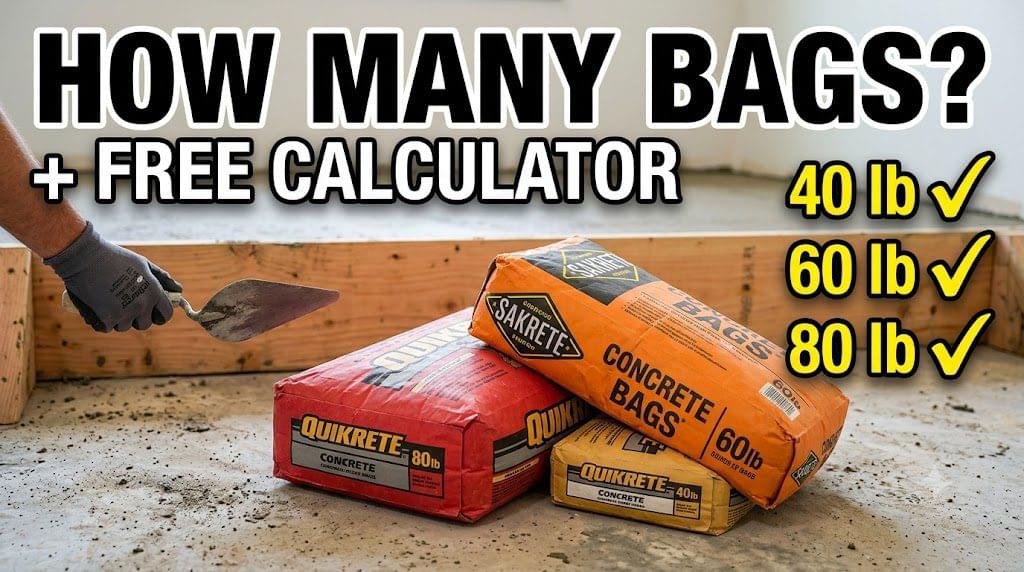
Bagged mix (40 lb, 60 lb, or 80 lb bags) is ideal for:
- Projects under 1 cubic yard
- Remote locations where a truck can’t access
- Small repairs, fence posts, or single footings
Bag yield reference:
| Bag Size | Yield per Bag | Bags Needed per Cubic Yard |
|---|---|---|
| 40 lb | 0.30 ft³ | 90 bags |
| 50 lb | 0.375 ft³ | 72 bags |
| 60 lb | 0.45 ft³ | 60 bags |
| 80 lb | 0.60 ft³ | 45 bags |
Example: Your project requires 1.5 cubic yards. Using 80 lb bags, you need 1.5 × 45 = 67.5 bags. With a 10% waste buffer, round up to 75 bags.
When to Order Ready-Mix Concrete
Ready-mix is delivered by truck and is the better choice for:
- Projects 1 cubic yard or larger
- Any slab where consistency and strength are critical
- Jobs where mixing 60+ bags by hand is impractical
What to know:
- A standard truck holds 8–10 cubic yards
- Minimum orders are often 1 yard
- Short-load fees may apply for orders under 5–7 yards
- Average cost: $125–$175 per cubic yard (varies by region and PSI)
Understanding the Waste Factor: Why You Always Order Extra
Running short on concrete is one of the most expensive mistakes in construction. If a ready-mix truck leaves and you need another half yard, you’ll pay a full short-load fee plus delivery charges.
What causes waste?
- Spillage: Concrete splashes during the pour and finishing
- Over-excavation: Your hole or form is deeper than planned in spots
- Uneven subgrade: The ground beneath your slab isn’t perfectly level
- Form gaps: Leaky forms lose material
The rule: Add 5–10% to your total volume. For irregular shapes or difficult access, use 10–15%.
Common Mistakes When Calculating Concrete
Even experienced DIYers make these errors. Avoid them:
1. Forgetting to convert inches to feet
If your slab is 4 inches thick, you must use 0.333 in your formula, not 4. Using 4 would make your result 12 times too large.
2. Mixing units
Never multiply feet by inches. Convert everything to one unit first.
3. Ignoring the subbase
Your concrete sits on gravel. If your gravel base is too thick or uneven, your actual concrete depth changes. Measure from the top of your compacted subbase to the top of your forms.
4. Ordering exactly the calculated amount
Always include the waste buffer. It’s cheaper to dispose of a quarter yard of extra concrete than to stop a pour and wait for a second truck.
5. Confusing diameter and radius
For round columns, remember the formula uses radius (half the diameter). Using the full diameter doubles your volume.
Quick Reference: Concrete Volume Cheat Sheet
| Project Dimensions | Thickness | Cubic Feet | Cubic Yards | 80 lb Bags (with 10% waste) |
|---|---|---|---|---|
| 10 ft × 10 ft slab | 4 in | 33.3 | 1.23 | 50 |
| 10 ft × 10 ft slab | 6 in | 50.0 | 1.85 | 75 |
| 12 ft × 12 ft slab | 4 in | 48.0 | 1.78 | 72 |
| 12 ft × 12 ft slab | 6 in | 72.0 | 2.67 | 108 |
| 20 ft × 20 ft driveway | 5 in | 166.7 | 6.17 | 250 |
| 20 ft × 20 ft driveway | 6 in | 200.0 | 7.41 | 300 |
| 8-inch diameter pier × 3 ft deep | — | 1.05 | 0.04 | 2 |
Frequently Asked Questions
How do I calculate how much concrete I need by hand?
Multiply length × width × thickness in feet to get cubic feet. Divide by 27 to convert to cubic yards. Add 5–10% for waste. For round shapes, use π × r² × height instead of length × width.
How many bags of concrete do I need for 1 cubic yard?
You need approximately 45 bags of 80 lb concrete, 60 bags of 60 lb concrete, or 90 bags of 40 lb concrete per cubic yard.
How much concrete do I need for a 10×10 slab?
At 4 inches thick, a 10×10 ft slab requires 1.23 cubic yards (about 50 bags of 80 lb concrete with waste). At 6 inches thick, you need 1.85 cubic yards.
What is the standard thickness for a concrete driveway?
Residential driveways should be 5–6 inches thick with 4,000 PSI concrete. In freeze-thaw climates, use air-entrained concrete.
Can I pour concrete directly on dirt?
No. You need a 4-inch compacted gravel subbase to prevent settling and cracking. The concrete should be poured on top of this base, not directly on soil.
How thick should a patio slab be?
Most residential patios are 4 inches thick. If you plan to park vehicles on the patio, increase the thickness to 5–6 inches and use reinforcement.
Final Checklist Before You Order
Before you call the batch plant or head to the hardware store, verify:
- [ ] All measurements are converted to the same unit (feet or meters)
- [ ] You used the correct formula for your shape (rectangle vs. cylinder)
- [ ] You added 5–10% for waste and spillage
- [ ] You decided between bagged mix and ready-mix based on total volume
- [ ] Your subbase is compacted and level
- [ ] You know the required PSI and thickness for your application
Get an Instant, Accurate Calculation
Manual math works, but one typo can cost you hundreds of dollars. Use our free Concrete Calculator to get instant results for slabs, footings, columns, walls, stairs, and more. Every calculator includes automatic conversion to cubic yards, cubic meters, cubic feet, and exact bag counts—plus the recommended waste buffer—so you can order with confidence and pour without stress.
Bottom line: Measure twice, calculate once, and always order a little extra. Your future self—and your finished slab—will thank you.

- How much will a 20kg bag of concrete cover? - July 30, 2026
- how do I calculate how much concrete I need? How to calculate Concrete volume - July 30, 2026
- Concrete volume calculator vs manual measurement: which is more accurate? - July 28, 2026