Quikrete Post Hole
Calculator
Enter your hole diameter and depth to get the exact number of Quikrete bags for fence posts, deck posts, and mailbox posts — plus a cost estimate. Free, no signup.
Enter your hole dimensions to see results — they’ll appear here automatically.
How many bags of Quikrete do you need?
The number of bags depends on the volume of your hole. This calculator finds that volume from your hole’s diameter and depth, subtracts the space your post will take up, then divides by how much concrete one bag yields once mixed — 0.30 ft³ for a 40 lb bag up to 0.60 ft³ for an 80 lb bag. It then rounds up, since you can’t buy part of a bag.
As a fast reference without opening the calculator, here’s what a single standard fence post hole typically needs:
| Hole depth | 50 lb bags | 80 lb bags |
|---|---|---|
| 24″ | 2 bags | 1 bag |
| 30″ | 3 bags | 2 bags |
| 36″ | 3 bags | 2 bags |
| 48″ | 4 bags | 3 bags |
Related calculators
Getting the concrete amount wrong on a fence or deck project is one of the most common — and most expensive — DIY mistakes. Too little and your posts wobble. Too much and you’re hauling bags back to the store. This guide gives you the exact number of Quikrete bags you need for any post hole size, with ready-to-use charts and the math explained step by step.
Quick Answer: How Many Bags of Quikrete Per Post Hole?
For a standard 6-inch diameter, 24-inch deep fence post hole, you will typically need 2 bags of Quikrete Fast-Setting Concrete (50 lb) or 1 bag of 80 lb Quikrete. For larger or deeper holes — such as deck posts — you may need 3 to 6 bags.
The exact number depends on three things:
- Hole diameter (usually 3× the post width)
- Hole depth (usually 1/3 of the post’s above-ground height, minimum 24 inches)
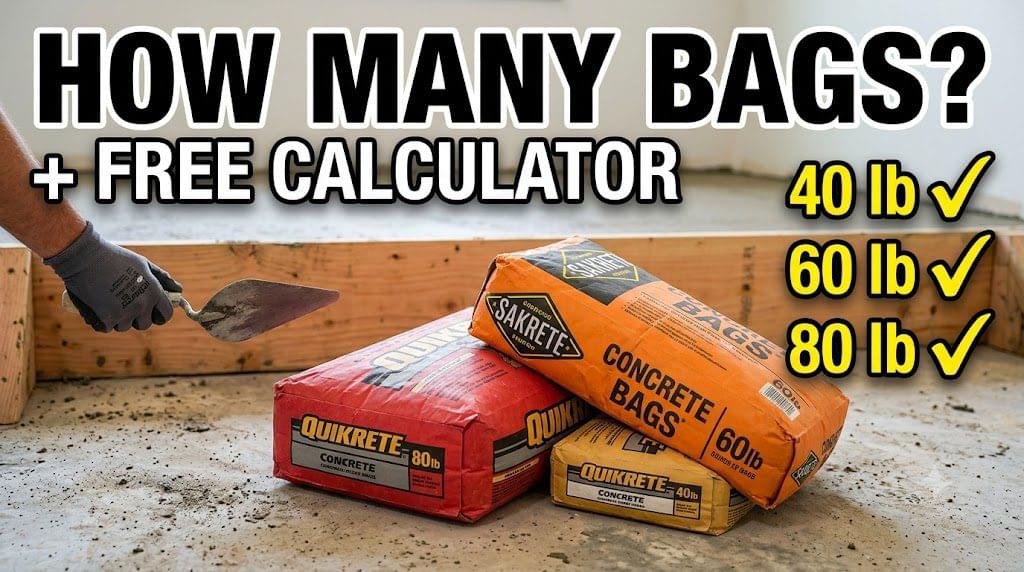
- Bag size (Quikrete comes in 40 lb, 50 lb, 60 lb, and 80 lb bags)
Use the chart below for the most common scenarios, or scroll down for the full calculation method.
Quikrete Bags Per Post Hole — Quick Reference Chart
The table below assumes you are filling the hole with concrete (no gravel base). Measurements are in inches.
| Hole Diameter | Hole Depth | 40 lb Bags | 50 lb Bags | 60 lb Bags | 80 lb Bags |
|---|---|---|---|---|---|
| 6 in | 24 in | 3 | 2 | 2 | 1 |
| 6 in | 30 in | 4 | 3 | 3 | 2 |
| 6 in | 36 in | 5 | 4 | 3 | 2 |
| 8 in | 24 in | 4 | 3 | 3 | 2 |
| 8 in | 30 in | 5 | 4 | 4 | 3 |
| 8 in | 36 in | 7 | 5 | 5 | 3 |
| 10 in | 30 in | 8 | 6 | 5 | 4 |
| 10 in | 36 in | 9 | 7 | 6 | 5 |
| 12 in | 36 in | 13 | 10 | 9 | 7 |
| 12 in | 48 in | 17 | 14 | 11 | 9 |
Pro Tip: Always buy 1 extra bag. Soil conditions vary, and some holes require slightly more concrete than calculated.
How to Calculate Quikrete Bags for a Post Hole (Step by Step)
Understanding the math helps you calculate for any hole size — not just the ones in the chart.
Step 1: Calculate the Volume of the Hole
A post hole is a cylinder. The formula for the volume of a cylinder is:
Volume = π × r² × h
Where:
- π = 3.14159
- r = radius of the hole (diameter ÷ 2), in feet
- h = depth of the hole, in feet
Example: 8-inch diameter hole, 30 inches deep
- Radius = 4 inches = 0.333 feet
- Depth = 30 inches = 2.5 feet
- Volume = 3.14159 × (0.333)² × 2.5 = 0.87 cubic feet
Step 2: Subtract the Post Volume
Your post takes up space in the hole. If using a 4×4 post (actual size 3.5″ × 3.5″), the volume of the post in the hole is:
- 3.5 in × 3.5 in × 30 in = 367.5 cubic inches = 0.213 cubic feet
Remaining concrete volume = 0.87 − 0.213 = 0.657 cubic feet
For fence posts, many contractors skip this subtraction since the post volume is small. For large deck posts (6×6 or bigger), include it for accuracy.
Step 3: Convert to Bags
Quikrete lists the yield (how much concrete each bag makes) on its packaging:
| Bag Size | Yield (cubic feet) |
|---|---|
| 40 lb | 0.30 cu ft |
| 50 lb | 0.375 cu ft |
| 60 lb | 0.45 cu ft |
| 80 lb | 0.60 cu ft |
Number of bags = Concrete volume ÷ yield per bag
Using the example above (0.657 cu ft) with 50 lb bags:
- 0.657 ÷ 0.375 = 1.75 → round up to 2 bags
With 80 lb bags:
- 0.657 ÷ 0.60 = 1.09 → round up to 2 bags
Which Bag Size Should You Buy?
This depends on the scale of your project and how much you want to carry.
40 lb Bags — Best for Small Projects or One Person
- Easy to mix and carry
- Good for mailbox posts, small fence posts, light-duty anchors
- You’ll need more bags, but each is manageable
50 lb Bags — The Sweet Spot for Fence Projects
- Popular choice for residential fence installations
- Easy to handle, widely available at Home Depot and Lowe’s
- Ideal if you’re mixing 3–5 holes solo
60 lb Bags — Middle Ground
- Less commonly stocked than 50 lb or 80 lb
- A good option when 80 lb feels too heavy
80 lb Bags — Best for Deck Posts and Large Holes
- Fewest bags to carry and mix per hole
- Best value per pound of concrete
- Harder to handle alone — consider 50 lb if working solo
- Best for deep holes (36″+) and large-diameter deck footings
Quikrete Product Options for Post Holes
Not all Quikrete products work the same way. Here are the three most common ones used for post holes:
1. Quikrete Fast-Setting Concrete (No-Mix)
- Best for: Fence posts, mailbox posts, sign posts
- How it works: Pour the dry mix directly into the hole around the post, then add water. No mixing required.
- Sets in: 20–40 minutes
- When to use: When you need to set the post and move on quickly, or when you’re working alone and can’t hold the post plumb while mixing
2. Quikrete Concrete Mix (Standard)
- Best for: Deck posts, large structural footings
- How it works: Mix with water in a wheelbarrow or mixer before pouring
- Sets in: 24–48 hours before load bearing
- When to use: When you need maximum strength and you’re mixing in batches
3. Quikrete High-Early Strength Concrete
- Best for: Cold-weather pours where faster set time is critical
- When to use: When temperatures are between 40°F and 65°F and a fast return to service is needed
Post Hole Size Guidelines
Before calculating bags, make sure your hole is the right size. Using the wrong hole dimensions is the most common cause of post failure.
Hole Diameter
- Rule of thumb: 3 times the post width
- 4×4 post → 12-inch diameter hole
- 6×6 post → 18-inch diameter hole
- Minimum: Never go smaller than 3× the post width. Wider holes mean more concrete and a more stable post.
Many fence contractors use an 8-inch diameter hole for 4×4 posts to save on concrete. This is acceptable in most residential applications with good soil.
Hole Depth
- Rule of thumb: 1/3 of the above-ground post height, plus 6 inches
- A post that stands 6 feet above ground needs at least 24 inches (2 feet) of depth
- A post that stands 8 feet above ground needs at least 32–36 inches of depth
- Frost line: In cold climates, the hole must go below the frost line to prevent heaving. Check your local frost depth — in northern states this can be 36–48 inches.
| Post Height (above ground) | Recommended Hole Depth |
|---|---|
| 4 ft | 18–24 in |
| 6 ft | 24–30 in |
| 8 ft | 30–36 in |
| 10 ft | 36–42 in |
How to Set a Post with Quikrete: Step-by-Step
Method 1: Fast-Setting (No-Mix) Method
- Dig the hole to the correct diameter and depth
- Add 3–4 inches of gravel at the bottom for drainage (optional but recommended)
- Place the post in the hole and brace it plumb (level on two sides)
- Pour the dry Quikrete into the hole around the post in 3–4 inch layers
- Add water at the rate of 1 gallon per 50 lb bag — pour slowly around the edges
- Do not mix — just add water and let it absorb
- Check plumb again and hold in place for 4 minutes
- Leave undisturbed for 4 hours before any load
Method 2: Standard Mix Method
- Dig the hole to the correct size
- Add gravel base (3–4 inches)
- Mix concrete in a wheelbarrow — use the ratio on the bag (typically 3 quarts of water per 80 lb bag)
- Pour concrete into the hole in 6-inch lifts, rodding with a stick to eliminate air pockets
- Set the post, check plumb on both faces
- Slope the top of the concrete slightly away from the post to shed water
- Brace the post and allow 24–48 hours before backfilling or loading
Most Asked Questions About Quikrete and Post Holes
How many bags of Quikrete for a 4×4 fence post?
For a 4×4 fence post in an 8-inch diameter, 24-inch deep hole, you need 2 bags of 50 lb Quikrete or 1 bag of 80 lb Quikrete. If your hole is 30 inches deep (common in areas with a frost line), use 3 bags of 50 lb or 2 bags of 80 lb.
How many bags of Quikrete for a 6×6 post?
A 6×6 deck or pergola post typically uses a 12-inch diameter hole, 36–48 inches deep. That requires:
- 36-inch depth: 9–10 bags of 50 lb, or 6–7 bags of 80 lb
- 48-inch depth: 12–14 bags of 50 lb, or 8–9 bags of 80 lb
How many bags of Quikrete for a mailbox post?
A mailbox post hole is typically 6 inches in diameter and 24 inches deep. You need 1 bag of 80 lb Quikrete or 2 bags of 40 lb Quikrete. Fast-Setting Concrete is ideal for mailbox posts.
Can I use one 80 lb bag of Quikrete per post?
Yes — for a standard 6-inch diameter, 24-inch deep hole, one 80 lb bag is sufficient. However, for any hole larger or deeper than that, you’ll need more. Never under-fill a post hole; a properly set post needs solid concrete contact along its full buried depth.
How much water do I add to Quikrete?
- Fast-Setting: 1 gallon of water per 50 lb bag (poured into the hole after dry mix)
- Standard Mix: approximately 3 quarts of water per 80 lb bag (mixed before pouring)
Add water slowly. Concrete that is too wet is weaker. The mix should look like thick oatmeal — wet enough to pour but not soupy.
How long does Quikrete take to set in a post hole?
- Fast-Setting Concrete: Initial set in 20–40 minutes; strong enough to handle light loads in 4 hours
- Standard Concrete Mix: Initial set in 1–2 hours; full working strength in 24–48 hours
- Full cure: All Quikrete products reach full strength at 28 days
Temperature affects set time significantly. Below 50°F, set time increases dramatically. Above 90°F, set time decreases — mist the concrete to slow it down.
Should I put gravel in the bottom of a post hole before concrete?
Yes, for most applications. Add 3–6 inches of gravel (crushed stone or pea gravel) to the bottom of the hole before setting the post. This:
- Prevents the end grain of the post from sitting in standing water
- Allows drainage so the concrete base doesn’t crack from freeze-thaw cycles
- Extends the life of wooden posts significantly
Skip the gravel only if you are pouring a full concrete footing (structural deck posts) where the post will sit on top of cured concrete.
How deep should a fence post be in concrete?
At least 1/3 of the total post length. For a 6-foot fence with 8-foot posts (6 ft above ground, 2 ft below), the post should be set in concrete at least 24 inches deep. In northern states, go deeper than the frost line — often 36–42 inches.
Is it OK to just put gravel around a fence post instead of concrete?
Gravel-only settings work in well-draining sandy or rocky soils for light-duty applications (garden borders, non-structural fencing). However, for any fence 4 feet tall or higher, security fencing, gate posts, or deck posts, always use concrete. Posts set in gravel alone are significantly more prone to leaning and blow-over in high winds.
How many bags of Quikrete are in a pallet?
A standard pallet of Quikrete contains:
- 80 lb bags: 42 bags per pallet (3,360 lbs)
- 50 lb bags: 56 bags per pallet (2,800 lbs)
- 40 lb bags: 80 bags per pallet (3,200 lbs)
Buying by the pallet is cost-effective for large fence projects (20+ posts).
Can I use Quikrete without mixing it for post holes?
Yes — Quikrete Fast-Setting Concrete is specifically designed to be poured dry into the hole and then have water added on top. Do not use standard Quikrete Concrete Mix or Quikrete Sand Mix this way; those products must be mixed before pouring. Only the Fast-Setting product is rated for the dry-pour method.
What is the difference between Quikrete and Sakrete?
Both are ready-mix concrete products with similar performance. Quikrete is the most widely distributed brand in the US. Sakrete is also widely available, especially in eastern states. Both offer fast-setting and standard versions. For bag-per-bag yield and strength, they are functionally equivalent — use whichever is cheaper or more available in your area.
How many fence posts can I set with one bag of Quikrete?
One 80 lb bag yields approximately 0.60 cubic feet of concrete — enough to fill one standard 6-inch × 24-inch fence post hole. You get one post per 80 lb bag for most fence applications.
Cost Estimate: How Much Does Quikrete Cost Per Post Hole?
Quikrete prices (as of 2025) at major retailers:
| Bag Size | Avg. Price | Cost Per Post Hole (6″×24″) |
|---|---|---|
| 40 lb | $5.50–$6.50 | $11–$13 (2–3 bags) |
| 50 lb | $6.50–$7.50 | $13–$15 (2 bags) |
| 80 lb | $9.00–$11.00 | $9–$11 (1 bag) |
Bottom line: 80 lb bags give you the best cost per cubic foot of concrete. Buy them if you can handle the weight.
Quikrete Post Hole Calculator
Use our free Quikrete Post Hole Calculator to get an instant, accurate bag count for your exact hole dimensions. Enter your hole diameter, depth, post size, and bag size — and we’ll give you the precise number of bags needed plus total cost estimates.
Final Tips Before You Pour
- Call 811 before digging. In the US, calling 811 gets your underground utilities marked for free. Hitting a gas or electric line is a serious hazard.
- Check local code. Many municipalities require permits for fences over 6 feet and decks. Your local building department can tell you the required footing depth.
- Buy 10% extra. Soil voids, irregular holes, and spillage mean you’ll almost always use slightly more concrete than calculated.
- Work in the shade or cool hours. Hot weather causes concrete to set too fast. Pour in the early morning in summer.
- Slope the top. After setting the post, shape the top of the wet concrete into a gentle slope (crown) that sheds rainwater away from the post. This is the single biggest thing you can do to extend wooden post life.
Summary
| Scenario | Bags Needed (50 lb) | Bags Needed (80 lb) |
|---|---|---|
| Mailbox post (6″×18″) | 1 | 1 |
| Fence post, 4×4, standard depth | 2 | 1 |
| Fence post, 4×4, frost country | 3 | 2 |
| Gate post, 4×4, 36″ deep | 4 | 3 |
| Deck post, 6×6, 48″ deep | 13–14 | 8–9 |
For any hole dimensions not in this guide, use our free Quikrete calculator at ConcreteCaclulatorz.com to get an exact bag count in seconds.
Last updated: May 2026 | Sources: Quikrete product specifications, ACI concrete standards, IRC building code frost depth tables

- How much will a 20kg bag of concrete cover? - July 30, 2026
- how do I calculate how much concrete I need? How to calculate Concrete volume - July 30, 2026
- Concrete volume calculator vs manual measurement: which is more accurate? - July 28, 2026