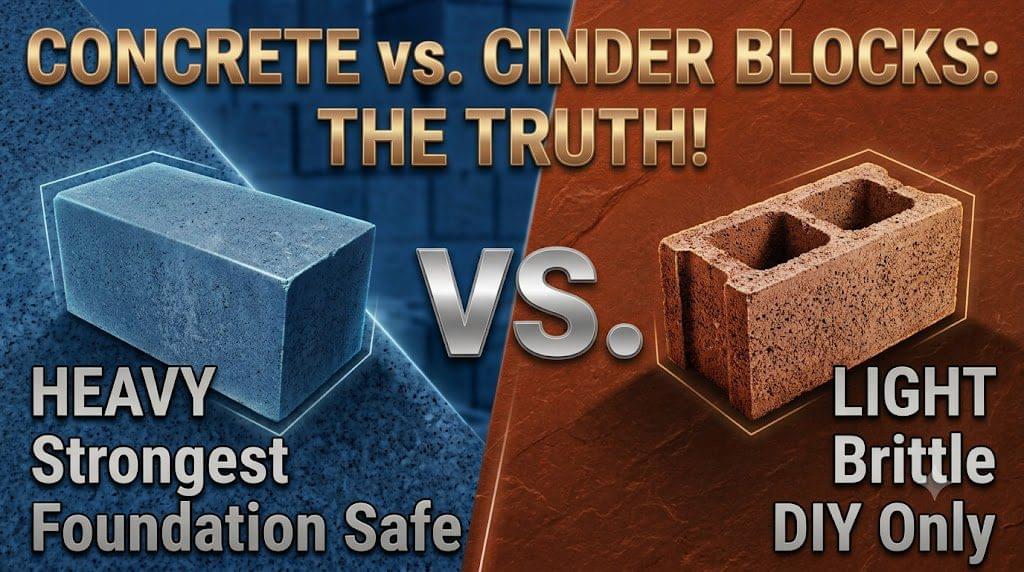
Choosing the right masonry material can save you thousands of dollars and decades of maintenance headaches. Whether you’re building a new home, adding a retaining wall, or planning a commercial project, the concrete block vs brick debate directly impacts your budget, timeline, and long-term satisfaction.
This guide breaks down everything you need to know—costs, durability, insulation, aesthetics, and real-world performance—so you can make the smartest choice for your specific project.
What Are Concrete Blocks and Bricks?
Before comparing, let’s clarify what we’re actually talking about.

Concrete blocks (also called Concrete Masonry Units or CMUs) are rectangular blocks made from Portland cement, water, sand, and gravel aggregate. They come in hollow or solid varieties, typically measuring 8″ × 8″ × 16″ for standard construction blocks. Modern concrete blocks often include fly ash or slag to improve strength and reduce environmental impact.
Bricks are smaller, rectangular units traditionally made from clay that’s fired in a kiln at temperatures exceeding 1,800°F. Standard bricks measure roughly 3-5/8″ × 2-1/4″ × 8″. While traditional clay bricks remain popular, concrete bricks (made from similar materials as blocks but in brick form) and calcium silicate bricks offer alternative options.
Cost Comparison: Which Saves You More Money?
Upfront Material Costs
| Material | Average Cost per Unit | Cost per Square Foot (Installed) |
|---|---|---|
| Standard Concrete Block | $1.50 – $3.00 | $10 – $15 |
| Clay Brick | $0.50 – $1.50 each | $14 – $30 |
| Concrete Brick | $0.40 – $0.90 each | $12 – $20 |
The surprise: While individual bricks cost less per unit, you need significantly more of them to cover the same area. A single standard concrete block equals the wall area of approximately 6-7 bricks. When you factor in labor, brick installation typically costs 40-100% more than concrete block installation.
Labor and Installation
Concrete blocks install faster because of their larger size. A skilled mason can lay roughly 75-125 blocks per day versus 300-500 bricks. However, brickwork requires less mortar per square foot and offers more flexibility for intricate patterns.
Bottom line: For budget-conscious projects, concrete blocks win on total installed cost. For premium aesthetic projects where appearance justifies the expense, brick remains the preferred choice.
Strength and Durability: What Lasts Longer?
Compressive Strength
- Concrete blocks: 1,900 – 4,000+ PSI (pounds per square inch) depending on mix and density
- Clay bricks: 3,000 – 5,000+ PSI for high-quality fired clay
- Concrete bricks: 2,500 – 4,500 PSI
High-density concrete blocks can match or exceed brick strength, making them suitable for load-bearing walls in multi-story construction. However, not all concrete blocks are created equal—lightweight blocks used for non-load-bearing partitions may only reach 1,000 PSI.
Weather and Moisture Resistance
Brick advantages:
- Fired clay is virtually impervious to moisture absorption when properly manufactured
- Excellent freeze-thaw resistance in cold climates
- Natural color that doesn’t fade or require painting
- Resistant to pest damage (termites, rodents)
Concrete block advantages:
- Superior resistance to heavy impacts and structural stress
- Better performance in seismic zones when reinforced with steel and filled with concrete
- Less susceptible to efflorescence (white mineral deposits) than lower-grade bricks
- Can be manufactured with integral water repellents
The catch: Standard concrete blocks are porous. Without proper sealing, waterproofing, or application of stucco/vinyl siding, they can absorb moisture. This is why you rarely see bare concrete block exterior walls in residential construction—they’re typically covered with another material.
Lifespan Expectations
Both materials can last 50-100+ years when properly installed and maintained. Historic brick structures from the 1800s still stand strong. Concrete block buildings from the mid-20th century remain structurally sound but may show cosmetic wear if not maintained.
Winner: Tie for longevity, with brick having a slight edge in aesthetic durability and concrete block in structural load-bearing capacity.
Energy Efficiency and Insulation
Thermal Performance (R-Values)
| Wall Assembly | Approximate R-Value |
|---|---|
| 8″ Solid Concrete Block | R-1.1 – R-1.5 |
| 8″ Hollow Concrete Block (unfilled) | R-1.9 – R-2.5 |
| Standard Clay Brick Wall | R-0.8 – R-1.2 |
| Block with Foam Insulation | R-10 – R-15 |
| Brick with Cavity Insulation | R-13 – R-18 |
Critical insight: Neither material provides significant insulation on its own. Both require additional insulation to meet modern energy codes. However, concrete blocks offer a major advantage for insulation integration.
Why Blocks Win on Insulation
- Hollow cores can be filled with foam insulation, vermiculite, or perlite, dramatically improving R-values without increasing wall thickness
- Continuous insulation systems attach easily to block walls
- Insulated Concrete Forms (ICFs)—a specialized block system—deliver R-20+ ratings while maintaining concrete’s structural benefits
Brick walls typically require built-out framing or exterior insulation boards to achieve comparable energy performance, adding cost and complexity.
Winner for energy efficiency: Concrete blocks, due to easier integration of modern insulation systems.
Fire Resistance and Safety
Both materials are non-combustible and rate highly for fire safety:
- Concrete blocks: 2-4 hour fire ratings depending on thickness and density
- Clay bricks: Excellent fire resistance; individual bricks can withstand temperatures above 1,800°F without degradation
For fire-rated walls, multi-family housing, and commercial buildings, concrete block assemblies are often specified because they meet code requirements more economically. Brick veneer over wood framing provides less fire protection than solid masonry but still outperforms vinyl or wood siding.
Winner: Tie—both exceed typical residential and commercial fire safety requirements.
Soundproofing and Acoustic Performance
Concrete blocks provide superior sound attenuation due to their mass and density. A standard 8″ concrete block wall achieves an STC (Sound Transmission Class) rating of 45-50, while a standard brick wall rates 40-45 STC.
For buildings near highways, airports, or in noisy urban environments, concrete block construction significantly reduces exterior noise intrusion. Filling block cores with sand or insulation further improves acoustic performance.
Winner: Concrete blocks for noise reduction.
Aesthetic Appeal and Design Flexibility
Brick: Timeless and Versatile
- Color variety: Hundreds of natural earth tones from cream to deep burgundy
- Texture options: Smooth, wire-cut, sand-faced, handmade appearances
- Pattern flexibility: Running bond, stack bond, herringbone, basket weave, and custom designs
- Architectural prestige: Associated with quality craftsmanship and traditional aesthetics
- Aging gracefully: Develops character through weathering and patina
Concrete Block: Modern and Industrial
- Raw aesthetic: Popular in contemporary, minimalist, and industrial designs
- Finish options: Can be ground, polished, stuccoed, or painted
- Split-face blocks: Offer rough, stone-like textures in various colors
- Glazed blocks: Provide glossy, colored finishes for interior and exterior use
- Size advantages: Larger units create bold, clean lines
The reality check: Most homeowners prefer brick for visible exterior walls because of its warmth and traditional appeal. Concrete blocks dominate in foundations, retaining walls, and commercial buildings where they’re hidden by other finishes.
Winner for aesthetics: Brick for residential and traditional architecture; concrete block for modern/industrial designs.
Maintenance Requirements
| Factor | Concrete Block | Brick |
|---|---|---|
| Cleaning | Pressure wash every 2-3 years if exposed; may require repainting/resealing | Occasional soft washing; no painting needed |
| Mortar joints | Inspect every 5-10 years; repoint as needed | Inspect every 10-20 years; repointing less frequent |
| Crack repair | More common due to settling; easier to patch | Less frequent; color-matched repair more challenging |
| Waterproofing | Essential for exposed exterior walls | Rarely needed for quality clay brick |
| Painting | Often required for aesthetic reasons | Generally unnecessary and discouraged |
Winner: Brick for lower long-term maintenance, assuming quality materials and proper installation.
Environmental Impact and Sustainability
Concrete Blocks
Concerns:
- Cement production contributes approximately 8% of global CO2 emissions
- High embodied energy due to cement manufacturing
- Mining of aggregates impacts local ecosystems
Improvements:
- Recycled content: Fly ash, slag, and recycled concrete can replace 20-50% of cement
- Carbon capture: Emerging technologies are reducing manufacturing emissions
- Local production: Often manufactured regionally, reducing transportation emissions
- Recyclability: Can be crushed and reused as aggregate
Clay Bricks
Concerns:
- Kiln firing requires significant energy (often fossil fuels)
- Clay extraction alters landscapes
- Transportation costs higher due to weight
Advantages:
- Natural materials: Clay is abundant and non-toxic
- Longevity: 100+ year lifespan reduces replacement frequency
- Recyclability: Can be cleaned and reused, or crushed for landscaping
- Thermal mass: Helps regulate indoor temperatures, reducing HVAC energy
The sustainable choice: Both materials are improving. For maximum sustainability, look for concrete blocks with high recycled content or bricks from manufacturers using renewable energy in firing.
Best Uses: When to Choose Which
Choose Concrete Blocks When:
✅ Building foundations and basements – Superior strength and moisture resistance when waterproofed
✅ Constructing retaining walls – Cost-effective and structurally sound
✅ Commercial and industrial buildings – Fast construction and code compliance
✅ Sound barriers and privacy walls – Excellent acoustic dampening
✅ Budget is a primary concern – Lower material and labor costs
✅ You plan to apply stucco, siding, or another finish – Hidden structural value
✅ Building in seismic zones – Better performance when reinforced
✅ Maximum insulation integration is needed – Easy to fill cores with foam
Choose Brick When:
✅ Curb appeal and resale value matter – Buyers consistently pay more for brick exteriors
✅ You want minimal maintenance – No painting, sealing, or frequent cleaning
✅ Historic or traditional architectural style – Authentic aesthetic match
✅ Fire safety is paramount – Excellent non-combustible properties
✅ Long-term color stability – Natural pigments won’t fade
✅ Premium commercial facades – Signals quality and permanence
✅ You’re building in extreme freeze-thaw climates – Superior weather resistance
✅ You want a material that ages beautifully – Develops character over decades
Common Myths Debunked
Myth 1: “Brick is always stronger than concrete block.”
Reality: High-density concrete blocks can exceed brick compressive strength. The key is specifying the right block grade for your application.
Myth 2: “Concrete blocks are ugly and only for industrial buildings.”
Reality: Modern architectural blocks include split-face, ground-face, and glazed options that rival stone and tile in appearance.
Myth 3: “Brick homes are maintenance-free.”
Reality: While lower maintenance than wood or vinyl, brick requires periodic mortar inspection and occasional repointing. Efflorescence and spalling can occur in poorly manufactured or installed brick.
Myth 4: “Concrete blocks are terrible insulators, so they’re bad for energy efficiency.”
Reality: No masonry wall provides adequate insulation alone. The difference is that concrete blocks more easily accommodate modern insulation systems to achieve high efficiency.
Making Your Final Decision: A Quick Checklist
Ask yourself these questions:
- What’s my budget? (Block for savings, brick for premium investment)
- Will the wall be visible or covered? (Brick for exposed, block for hidden)
- What’s my climate? (Brick for wet/freeze-thaw extremes, either for moderate climates)
- Do I need superior soundproofing? (Block wins)
- Is energy efficiency my top priority? (Block integrates insulation better)
- How long do I plan to own the property? (Brick may offer better resale ROI)
- What’s the architectural style? (Traditional = brick, Modern/Industrial = block)
- Are there local material availability issues? (Transportation affects both cost and carbon footprint)
Frequently Asked Questions
Can I use brick veneer over concrete block?
Yes, and this is an excellent hybrid approach. You get the structural strength and insulation potential of block with the aesthetic appeal of brick. This combination is common in high-quality residential construction.
Are concrete blocks cheaper than bricks?
Yes, for total installed cost. While individual bricks cost less, you need more units and more labor per square foot. Total installed costs for block walls typically run 30-60% less than solid brick walls.
Do concrete blocks need to be sealed?
Exposed exterior concrete blocks should be sealed or covered with stucco, siding, or paint to prevent moisture absorption. Foundation blocks below grade require waterproofing membranes.
Which is better for earthquake-prone areas?
Reinforced concrete block (filled with concrete and rebar) generally performs better than unreinforced brick. However, both materials can be engineered for seismic zones with proper reinforcement.
Can you paint concrete blocks to look like brick?
While possible, painted block rarely achieves authentic brick appearance. For the brick look at block cost, consider brick veneer over a block backup wall.
Conclusion: There’s No Universal Winner
The concrete block vs brick decision depends entirely on your project’s specific requirements, budget, and aesthetic goals.
Choose concrete blocks for structural efficiency, cost savings, soundproofing, and modern design flexibility. They’re the workhorse of masonry construction—practical, strong, and adaptable.
Choose brick when appearance, longevity, low maintenance, and traditional appeal justify the premium investment. Brick remains the gold standard for visible masonry that stands the test of time.
For many projects, the optimal solution combines both: concrete block for structure and insulation, brick veneer for beauty and weather protection. This hybrid approach delivers the best of both worlds while managing costs effectively.
Whatever you choose, invest in quality materials and skilled installation. Even the best block or brick will fail if poorly laid or improperly detailed. Consult with a structural engineer for load-bearing applications and always follow local building codes.
Ready to start your masonry project? Get quotes from licensed contractors specifying your material choice, and always verify that products meet ASTM standards for your application.

- How much will a 20kg bag of concrete cover? - July 30, 2026
- how do I calculate how much concrete I need? How to calculate Concrete volume - July 30, 2026
- Concrete volume calculator vs manual measurement: which is more accurate? - July 28, 2026